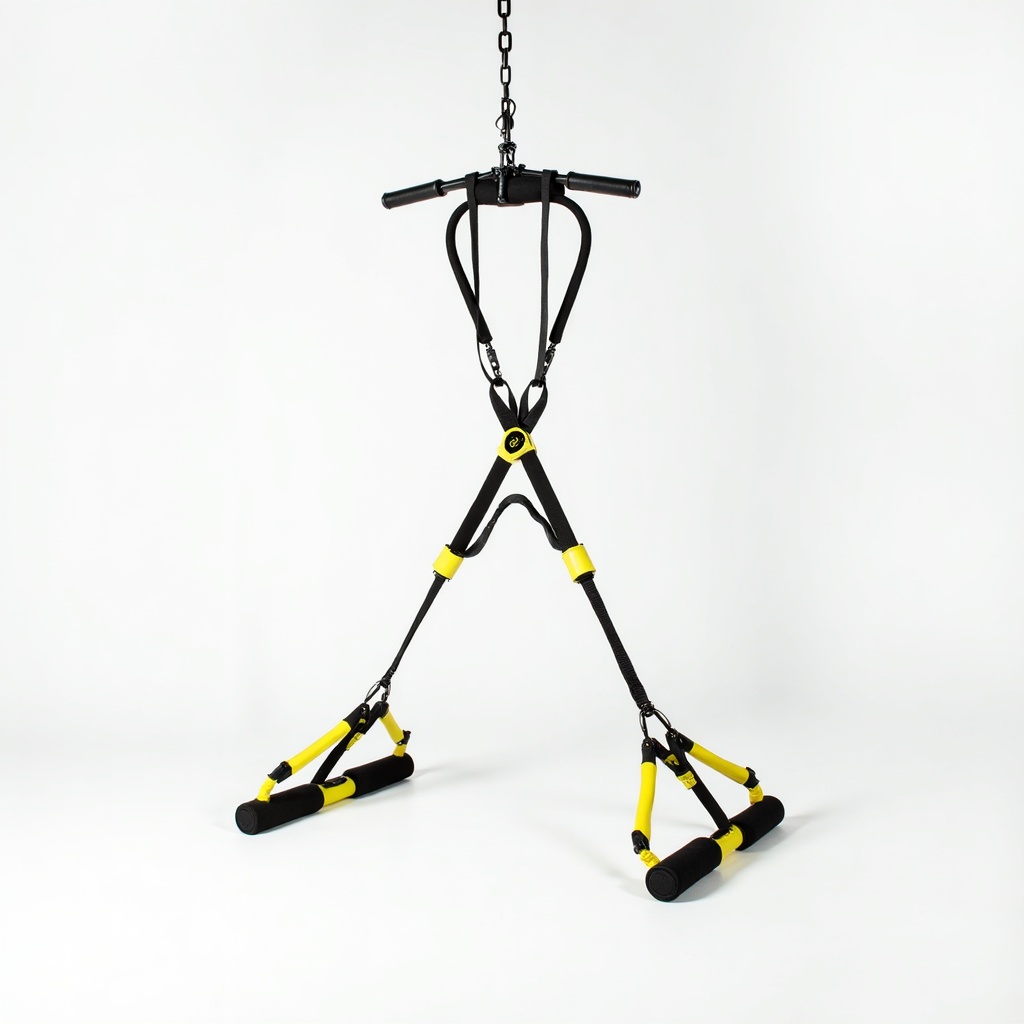
TRX GO Suspension Trainer Review

A full-body gym that packs into a bag—anchor it anywhere and train with your own bodyweight.
The TRX GO gives you a legitimate full-body workout from a single anchor point and a kit that fits in your carry-on. For people who refuse to skip leg day in a hotel room, that's the whole pitch.
What the TRX GO actually is
It's a pair of adjustable nylon straps with foot cradles and handles, plus a door anchor and a suspension anchor for beams, posts, or sturdy trees. You hang it, you grab it, and your bodyweight does the rest. Rows, chest presses, planks, lunges, single-leg squats. The angle of your body sets the difficulty, so the same gear works for a beginner and someone who can knock out fifty pushups.
The GO is the lightweight version of TRX's lineup. It weighs about a pound and packs into a small drawstring bag, which is the entire reason it exists. This is the one TRX sells to travelers and people with no spare floor space, not the gym-grade model bolted to a wall rack.
How it performs day to day
The training itself is genuinely good. Suspension work hammers your core on almost every move because you're constantly fighting to stay stable, and the strength carryover for rows and pressing is real. Owners consistently report it's harder than it looks, which is a compliment.
Setup is fast once you've done it twice. The door anchor slips over the top of a closed door and holds your weight against the frame, no hardware needed. It works, though it relies on you trusting a door, and there's a learning curve to getting the strap length dialed in for each exercise. The over-the-door anchor only works on doors that open away from you, so check that before you assume your hotel room qualifies.
Build quality is solid for the weight class. The straps and stitching are well-regarded, and TRX has a long reputation here. The GO uses lighter webbing and smaller handles than the TRX Pro, so if you've used a Pro at a gym, the GO will feel a touch less burly. For bodyweight training that's a non-issue for the vast majority of people.
The good and the annoying
Pros: it's light, it packs tiny, the workout is no joke, and it scales from total beginner to advanced just by changing your stance. One piece of kit replaces a rack of dumbbells for a lot of movements. The included app and follow-along workouts are a decent on-ramp if you've never done suspension training.
Cons: at roughly $100 to $150 it's not cheap for what is, physically, some straps and clips. You can find no-name suspension trainers for a third of the price. The door anchor needs a suitable door, the foot cradles are thinner than the Pro's, and the GO leans hard on resistance from bodyweight, so there's a ceiling once you can do everything one-handed. There's also a learning curve. Bad form on a suspension trainer feels easy and trains nothing.
Who should buy it, who should skip it
Buy the GO if you travel often, live somewhere small, or want a no-excuses workout you can stash in a backpack. It's our pick of the TRX line specifically for portability and for home users who don't need gym-grade hardware.
Skip it if you mostly train at home and have the wall space. The heavier TRX Pro feels better and costs only a little more for stationary use. Skip it too if you're chasing serious hypertrophy or heavy lower-body strength. You'll cap out, and a set of adjustable dumbbells does more for that goal. And if budget is tight, a cheaper suspension trainer covers 90 percent of the same ground.
The verdict
The TRX GO does exactly what it promises: a real full-body workout that disappears into a bag. You're paying a brand premium over generic straps, but you get the build quality and the ecosystem to back it up. For travelers and space-strapped trainers, it's an easy recommendation. For everyone else, decide whether you actually need it to be this portable.
Frequently asked questions
- What's the difference between the TRX GO and the TRX Pro?
- The GO is lighter and more packable with thinner straps and smaller handles, built for travel. The Pro uses heavier-duty webbing and more comfortable foot cradles for stationary home or gym use. For portability, get the GO. For a fixed setup, the Pro is worth the small upcharge.
- Can you really get a full workout with the TRX GO?
- Yes. It covers rows, presses, squats, lunges, planks, and core work, and difficulty scales with your body angle. The main limit is heavy lower-body strength, where dumbbells or a barbell still win.
- Do you need a door to use the TRX GO?
- No. It ships with a door anchor and a separate suspension anchor that loops around a beam, post, or sturdy tree. The door anchor only works on doors that open away from you, so the other anchor is handy for parks and gyms.
Daniel covers home, kitchen, and everyday-carry gear. He's a stickler for durability and value, and has no patience for overpriced hype.